
Automated Levels generation system
Automated Levels generation system
Game: Hitwicket – Multiplayer Cricket Strategy Game
Platform: Mobile (Android / iOS)
TL;DR
The Problem
New users were dropping off due to a lack of emotional engagement in the first 7 days. Matches felt repetitive and lacked the "tension" of real cricket.

The Solution
The "Drama Engine": A procedural system that uses real-time math (Rigs) and narrative templates to engineer scripted, "clutch" victories at scale.
Quick Facts
My Role: Lead Systems Designer
I was responsible for the core math logic, narrative templates scripting, and the internal Admin Tool.
The Goal
I was responsible for the core math logic, narrative templates scripting, and the internal Admin Tool.
The Stack
Unity, Google Sheets (Logic Modeling), and Custom Admin Tools.
The Impact
D7 Retention boosted by
Day 7 Retention boosted by
Level Design efficiency
Level Design efficiency
Levels Generated
Levels Generated
Game: Hitwicket – Multiplayer Cricket Strategy Game
Platform: Mobile (Android / iOS)
TL;DR
The Problem
New users were dropping off due to a lack of emotional engagement in the first 7 days. Matches felt repetitive and lacked the "tension" of real cricket.
The Solution
The "Drama Engine": A procedural system that uses real-time math (Rigs) and narrative templates to engineer scripted, "clutch" victories at scale.
Now lets dive deeper into the design process
The Problem
New players were winning, but they weren't feeling anything.
Our D7 retention was lagging. Players dropped off before experiencing the real magic of the game because the first 7 days lacked emotional stakes.
The Goal
Turn the onboarding phase into a sports movie.
We needed to bridge the gap between "playing a game" and "feeling the pressure of a real sport."

Quick Facts
My Role: Lead Systems Designer
I was responsible for the core math logic, narrative templates scripting, and the internal Admin Tool.
The Goal
I was responsible for the core math logic, narrative templates scripting, and the internal Admin Tool.
The Stack
Unity, Google Sheets (Logic Modeling), and Custom Admin Tools.
The Impact
D7 Retention boosted by
Level Design efficiency
Levels Generated
But, 3 things were killing the excitement...
1. Predictability Matches felt flat. You either won easily or lost badly.
2. No Narrative There was no "story" to the matches—just numbers going up.
3. Scale Hand-crafting 150 unique, dramatic matches for every user was impossible.
My Role
As a Systems Designer, I engineered the "emotions" that kept players hooked.
I treated the level design as a narrative problem, not just a math one. I asked...
"How can we code 'nervousness'?" "Can a system act like a movie director?"
🧑💻 ➡️ 🎬
Key Design Decisions
With this mindset, there were 3 pivotal systems that transformed the early game.
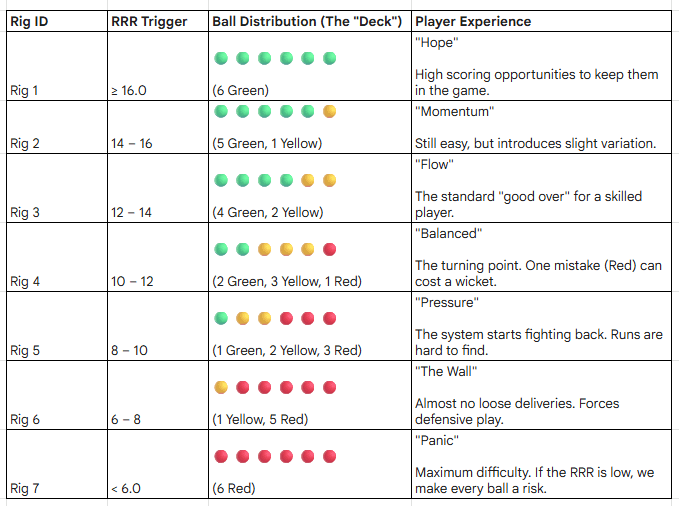
01 The "Close Matches Rigs"
Procedural Drama I designed a system that watches the match in real-time. If the game gets too boring, the "Rig" kicks in to adjust the difficulty of the next ball dynamically.
The Illusion: It simulates pressure (tough balls) followed by a "hero moment" (easy balls) to ensure the player wins, but feels like they almost lost.
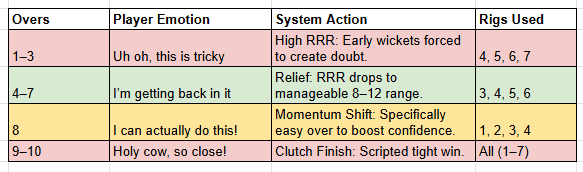
02 Narrative Templates
Shifting focus from Difficulty to Emotion Instead of just "Easy/Medium/Hard," I designed emotional archetypes.
The Comeback: You start losing, then the system hands you momentum.
The Trap: Starts easy, suddenly gets hard, ends with a nail-biter.
Tug of War: Constant back-and-forth tension.
Comeback
Tug Of War
The Trap
03 The opponent squad generator
Infinite Opponents, Perfect Balance. To support 15o+ matches, I built a generator that builds squads instantly.
Logic: It pulls from 4 Player Tiers (C to S) and adjusts the Power Ratio (e.g., 1.4x bowler strength for "Survival" levels).
Result: Opponents that feel distinct and "human" without manual entry.
🤖 ➡️ 👱
For configurability
An internal tool that let us build levels in seconds
I designed a modular Level Configurator that allowed us to "plug and play" match variables. This turned a complex backend system into a 30-second task for designers.
⚙️⚙️
My Impact
After the rollout, the Early Game System showed strong signs of success.

D7 Retention boosted by
Day 7 Retention boosted by
Level Design efficiency
Level Design efficiency
Levels Generated
Levels Generated
What I learned
This project taught me that emotions can be engineered.
By moving from static level design to Systems Thinking, we proved that you don't need randomness to create excitement, you just need the right rules.
"Players don't need randomness, they need drama. This system let us engineer the feeling of a last-ball victory."
Let's Get in Touch
Let's connect and build something together
Come say hi at abhichatterjee01@gmail.com
View my LinkedIn
Let's Get in Touch
Let's connect and build something together
Come say hi at abhichatterjee01@gmail.com
View my LinkedIn
Let's Get in Touch
Let's connect and build something together
Come say hi at abhichatterjee01@gmail.com
View my LinkedIn